
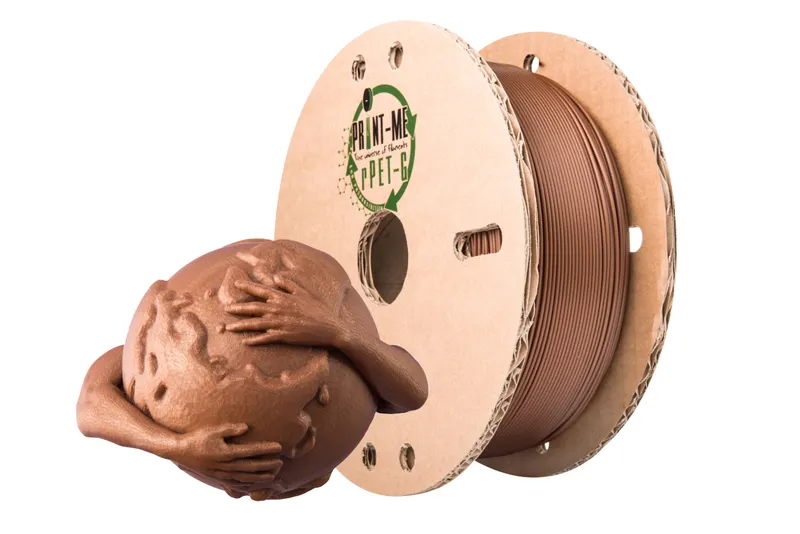
PRINT-ME rPETG Copper 1 kg
Product details
- Brand:
- Print-Me
- Category:
- Filament
Product description
rPET-G is made from recycled PET-G and wound on a cardboard spool.
rPET-G is a tough material – it is extremely durable and prints without odor. It prints very nicely with a surface quality similar to PLA. Thanks to its low shrinkage during printing, this material is suitable for printing large objects. Unlike other materials, PETG is more resistant to acids and solvents, as well as high and low temperatures. It is possible to heat-form a printed object from it or flame-polish it. This is another material that should be on your list right after PLA. PET-G can be quite harmful to the environment, so it is advisable to recycle it. Complete decomposition of PET-G takes decades.
Here are the main advantages of printing with this material and common properties of rPETG filament:
- Very durable; it is more flexible than PLA or ABS, but also a bit softer.
- It is difficult to break in half, so if you need an “unbreakable” case or cover, PETG beats almost everything (except Nylon 12).
- It has very low shrinkage, so there is no warping. Ideal for printing large parts.
- PETG is also very strong, not brittle, but it can be scratched more easily than ABS, which is harder.
- PETG is not very good for printing supports because it adheres extremely well. But because it adheres so well, layer adhesion is fantastic, making prints strong and durable.
- It also adheres well to the build plate, so be careful when removing it after printing.
- It has high chemical resistance along with resistance to bases, acids, and water.
- Printing is odorless.
rPET-G surface finishing:
It is advisable to first spray the print with a filler/primer (putty used in modeling), then sand and varnish it, repeatedly—until the surface is completely smooth—and finally spray with paint.
Bonding rPET-G:
Polyurethane adhesive, cyanoacrylate (super glue), and two-part epoxy are suitable for bonding PET-G.
Recommended print settings for rPET-G:
Commonly used nozzles are suitable. Diameters can be chosen according to the surface finish you want to achieve or according to the selected layer height. Printing temperature: 240 °C. A heated bed is not required, but for better adhesion the bed can be heated up to 75 °C.
For more information about 3D printing materials, you can use our material glossary https://3dstisk.cz/materialovy-slovnik/
For 3D printing tips, photos and videos of filaments, and current discounts, follow us on our social networks:
TikTok: https://www.tiktok.com/@3dstisk
Instagram: https://www.instagram.com/3dstisk/
Facebook: https://www.facebook.com/profile.php?id=100086437153541
Twitter: https://twitter.com/3dstisk
Youtube: https://www.youtube.com/@3dstisk


