
1 / 4
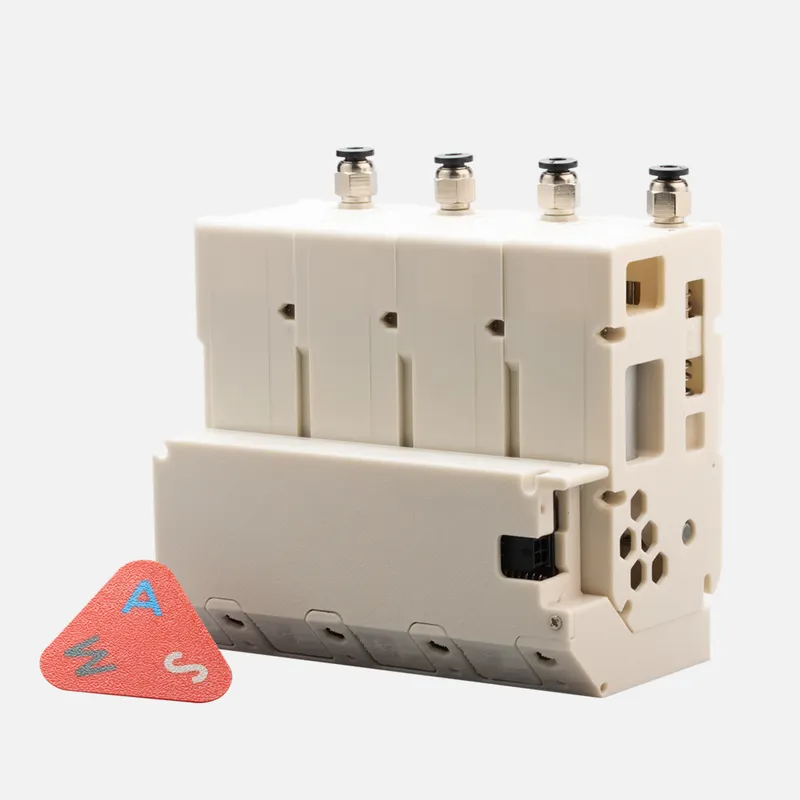
BMCU 370C assembled version - AMS alternative for Bambu Lab A1, A1 Mini and P1 - Used
Open, community alternative to AMS lite for Bambu Lab printers. Version 370C with hall buffer brings bidirectional buffering, smoother feeding, and lower noise. 4 channels for multi-color/multi-material printing, compatible with A1 and A1 mini; P1S/P1P only experimentally. Assembled variant.
2 490 Kč
Out of stock
Product details
- SKU:
- WC43371
- Brand:
- Bambu Lab
- Category:
- FDM 3D Tiskárny (filament)
Product description
The product was returned within 14 days, inspected and potentially repaired by a technician, packaging is complete.
If the printer offers an AMS update with BMCU connected, do not update the AMS firmware, as BMCU will stop working and you will have to manually re-upload the BMCU firmware.
Firmware A1/A1 mini 01.07 tested and supported. Functionality with newer firmware cannot be guaranteed. BMCU Firmware https://drive.google.com/drive/folders/1hdiSyvxWcIvtZG92uE7YCp_mhSPL9PZN BMCU 370C is an open-source alternative to Bambu AMS lite, which allows multi-color and multi-material printing on Bambu Lab printers. The 370C variant utilizes a hall buffer and is designed for stable, gentle, and quiet feeding of material. This version is assembled and includes a connection cable. Simply plug it into the printer and print. When connecting, it is important to turn off the printer, connect BMCU, and then turn the printer back on.Main benefits
- Bidirectional buffering and gentler feeding – reduces the risk of filament damage/clogging and supports "long retraction after cutting" during material change.
- Active feeding (370 motors) for reliable filament switching even with a longer material path.
- 4-filament system – simple solution for printing with up to 4 materials/colors. (Expansion beyond 4 filaments is currently not supported.)
- Open-source firmware and hardware with community documentation (CH32 series control MCU).
Compatibility
- Bambu Lab A1 and A1 mini – fully supported.
- P1S / P1P – experimental support (requires custom integration; functionality without warranty).
- X1 series – "possible, but unverified".
What to expect during assembly
BMCU 370C in this variant is already assembled and just needs to be connected to the printer. This is a community solution without RFID spool recognition.Key features
- 4 independent filament guides for multi-color/MMU printing.
- Hall buffer (version 370C): quieter operation and higher resistance to "overpressure" in the hub.
- Bidirectional buffering and long retraction after filament cutting.
- Active feeding with 370 motors.
- Open-source design, CH32 MCU, without RFID reader.
- Compatible with 1,75 mm filaments (PLA/PETG etc.; according to printer recommendations).
Technical parameters
| Parameter | Value |
|---|---|
| Number of filaments | 4 (no possibility of expansion beyond 4) |
| Version | 370C (hall buffer) |
| Feeding principle | Active feeding + bidirectional buffer |
| Control electronics | CH32 MCU (open-source firmware) |
| Compatibility | Bambu Lab A1, A1 mini; P1S/P1P (experimental); X1 (unverified) |
| Supported materials | 1,75 mm filament (according to printer specifications) |
| Extra functions | "Long retraction when cut in filament" |
| Sets | A–D (different kit completeness) |
| Requirements | 3D printed parts, basic soldering and calibration |
Who is BMCU 370C for
- Bambu A1/A1 mini users who want an affordable alternative to AMS lite.
- Printers who prefer DIY and open solutions and want flexibility (e.g., connection to dryers/dryboxes and external filament routing).
Package contents
- BMCU 370C assembled, PTFE tube, connection cable.
Key features:
- Open alternative to AMS lite for Bambu Lab A1/A1 mini.
- Hall buffer (370C) with bidirectional buffering – quieter and gentler operation.
- 4 channels for multi-color and multi-material printing.
- Active feeding with 370 motors for stable material changes.
- Community firmware/hardware (CH32 MCU), without RFID – simple configuration.
- Experimental support for P1S/P1P – possibility of integration, without guarantee of full compatibility.


