
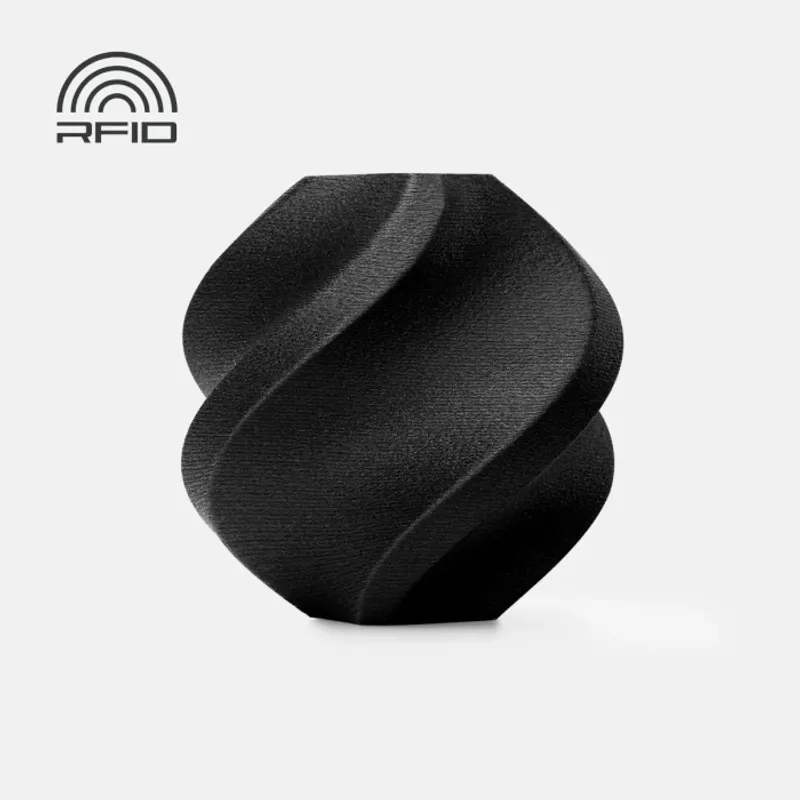
Bambu Lab PA6‑GF Black 1 kg
Product details
- SKU:
- 6975337036968
- Brand:
- Bambu Lab
- Category:
- Filament
Product description
Product Description
Bambu Lab PA6‑GF Black 1 kg is a top-tier technical filament based on nylon 6 (PA6) reinforced with glass fibers, designed for the production of extremely strong, stiff, and heat-resistant parts. Use it wherever requirements for mechanical properties, dimensional stability, and durability are much higher than with common printing materials.
Thanks to the glass fibers, PA6‑GF has a significantly higher modulus of elasticity, less tendency to deform, and minimized warping compared to classic nylons. At the same time, it maintains good toughness and impact resistance.
The black version Black (code 72104, HEX #000000) gives models a professional technical look, while a special surface texture suppresses layer visibility and ensures a very smooth and matte surface.
Main Advantages and Applications
- Glass fiber reinforced nylon 6 – significantly higher strength and stiffness than common PA, PLA, or PETG.
- High heat resistance – temperature resistance up to approximately 182 °C (HDT at 0.45 MPa), suitable for parts near engines, heating elements, or other heat sources.
- Excellent dimensional stability – lower shrinkage and deformation than standard nylons, suitable for precise technical components.
- Chemical resistance – resistant to oils, lubricants, and many solvents, making it ideal for industrial and workshop environments.
- Smooth, aesthetic surface – special surface texture masks layers, resulting in clean and professional-looking parts.
- AMS compatible – on Bambu Lab printers, convenient use in the AMS system (automatic material feeder) is possible, including multi-color combinations.
Typical Applications
- Functional prototypes and small series of parts
- Brackets, fixtures, clamps, preparation and measuring tools
- Machine parts, covers, and functional components
- Automotive industry parts – cable holders, mounts, fixtures
- Components exposed to higher temperatures and mechanical stress
Printing Recommendations
PA6‑GF is technical and moisture-sensitive, therefore requiring proper preparation and conditions:
Print Settings (approximate)
- Filament diameter: 1.75 mm ± 0.03 mm
- Nozzle temperature: approx. 260–290 °C
- Bed temperature (with glue): 80–100 °C
- Recommended print speed: up to 130 mm/s
- Nozzle type: hardened steel / hardened nozzle (0.4 / 0.6 mm). 0.2 mm nozzle is not supported, stainless steel nozzle not recommended due to abrasion.
- Compatibility: Bambu Lab printers, AMS compatible, AMS Lite incompatible.
Drying and Storage
- Always dry before printing – recommended 80 °C for 8–12 hours in a dryer or convection oven (with precise regulation).
- During printing, keep material in a dry box or in the AMS with desiccant.
- Store in a closed bag/box with desiccants, relative filament humidity < 20 % RH.
Bed and Adhesion
- A textured / engineering PEI plate is recommended using a suitable glue (e.g., glue stick) to improve adhesion.
- For larger parts, it is advisable to use a brim and let the bed and chamber preheat sufficiently to minimize warping.
Technical Material Parameters
Physical Properties (typical values)
| Property | Value |
|---|---|
| Density | approx. 1.14 g/cm³ |
| Vicat softening temperature | approx. 210 °C |
| Heat deflection temperature (HDT, 0.45 MPa) | approx. 182 °C |
| Melting temperature | approx. 219 °C |
| MFI (275 °C / 2.16 kg) | approx. 9.0 ± 0.8 g/10 min |
Mechanical Properties (approximate)
| Property | Value |
|---|---|
| Tensile strength | ~75 ± 6 MPa |
| Elongation at break | ~3.9 ± 0.8 % |
| Flexural modulus | ~3670 ± 140 MPa |
| Flexural strength | ~120 ± 6 MPa |
| Impact strength (Charpy) | ~27.2 ± 2.2 kJ/m² |
The values listed are typical laboratory values from the manufacturer and may vary slightly depending on printing conditions and print orientation.
Compatibility and Recommendations
- 3D printers: Ideal for Bambu Lab X1, X1C, P1S, P1P, A1 printers with a suitable nozzle and closed or tempered space.
- Automatic feeder: Fully compatible with Bambu AMS, but not with AMS Lite.
- Nozzle: Use hardened nozzles (PA6‑GF is an abrasive material and quickly wears down brass and stainless steel).
- Support use: It is recommended to use compatible supports (e.g., separate support material for PA/PET) and remove them within approx. 2 hours after printing, before the material absorbs moisture.
Summary
Bambu Lab PA6‑GF Black is a professional filament for users who need truly durable and temperature-stable parts. In combination with Bambu Lab printers, it provides reliable, precise, and fast printing of technical components with an excellent surface and long life. If PLA or PETG are no longer enough for you and you are looking for material for real-world use in industry, workshop, or motorsport, PA6‑GF is the ideal choice.
Key Features:
- High-performance technical filament based on nylon 6 reinforced with glass fibers (PA6‑GF)
- Extremely high strength, stiffness, and long-term durability in demanding conditions
- High heat resistance – temperature resistance up to approx. 182 °C (HDT at 0.45 MPa)
- Excellent dimensional stability and less warping compared to common nylons
- Good chemical resistance to oils, lubricants, and many solvents
- Matte, smooth surface that optically hides print layers
- Ideal for functional prototypes, fixtures, brackets, and machine parts in industry and automotive
- Full compatibility with Bambu Lab printers and AMS (Automatic Material System)
- RFID chip in the spool for automatic material profile loading in the printer
- Abrasive material – use of hardened nozzles recommended


